Viridelle
Contents
Identity
The Spring Court is one of the oldest continuously ruled Seelie kingdoms and the agricultural, medicinal, healing and fertility center of Seelie civilization. Its identity revolves around life in every form: birth, renewal, courtship, family, healing, cultivation and the violent determination of living things to survive.
Spring is not portrayed as purely gentle. The Court recognizes two complementary aspects of the season. Queen Rosellie represents growth, healing, fertility, beauty, celebration and cultivation. King Leander represents thorns, storms, territoriality, competition and aggressive new life.
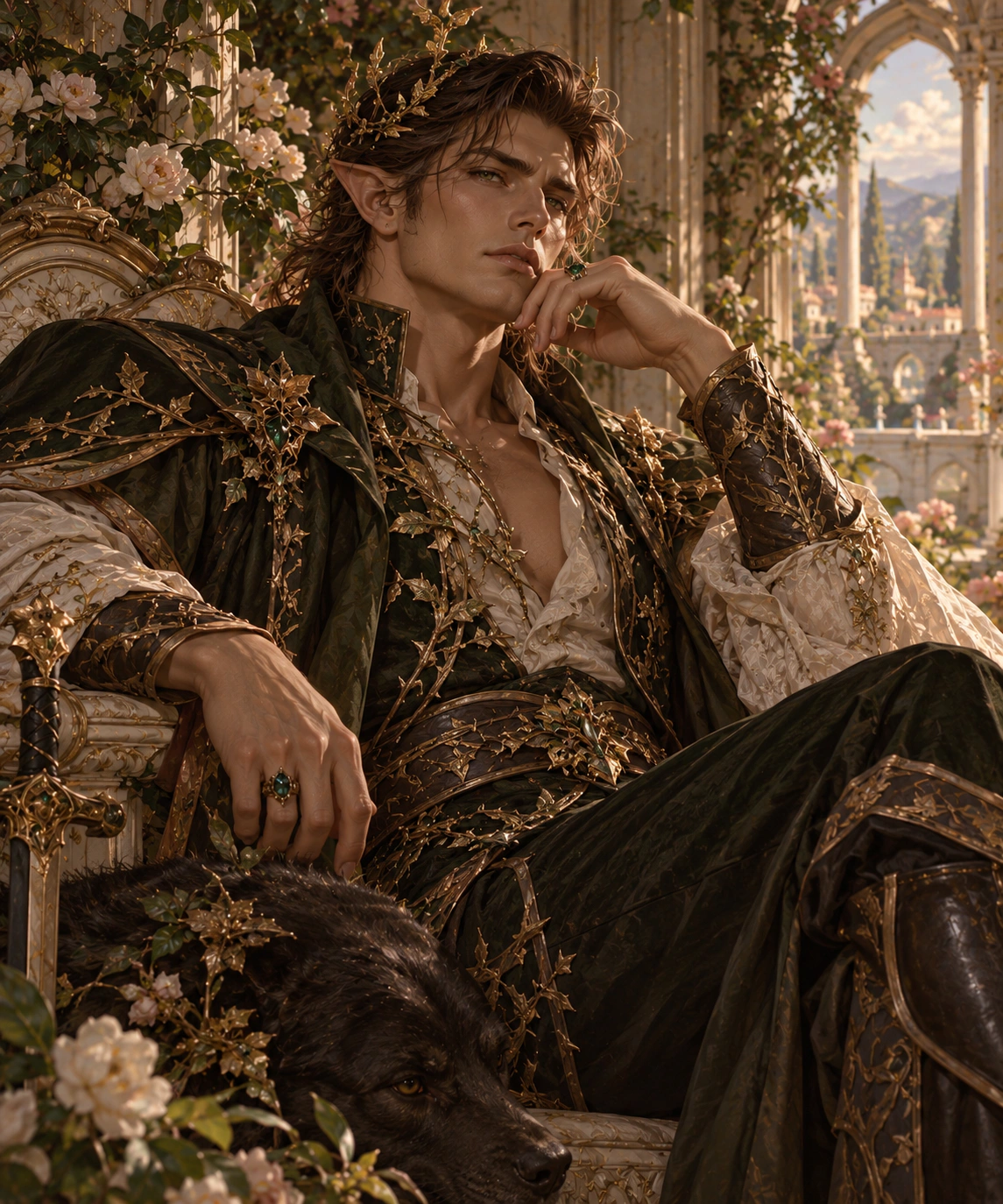
Its royal crest depicts a lush blush-pink peony representing Rosellie with an upright sword behind it representing Leander standing behind his queen as protector and partner.
Land and Climate
The entire Spring Court exists in perpetual magical spring. The season never progresses into summer, but this does not mean identical weather or continuous flowering. The land experiences the full range of spring conditions: cool rain, warm sunlight, mist, thunderstorms, occasional late cold, periods of rapid growth and changing flowering cycles.
The countryside is exceptionally fertile. Vast flower fields, orchards, farmland, medicinal gardens, flowering forests, rivers, waterfalls, meadows and cultivated valleys dominate the landscape.
Viridelle and the surrounding countryside gradually blend into one another. There is no abrupt point where the capital simply ends.
Viridelle
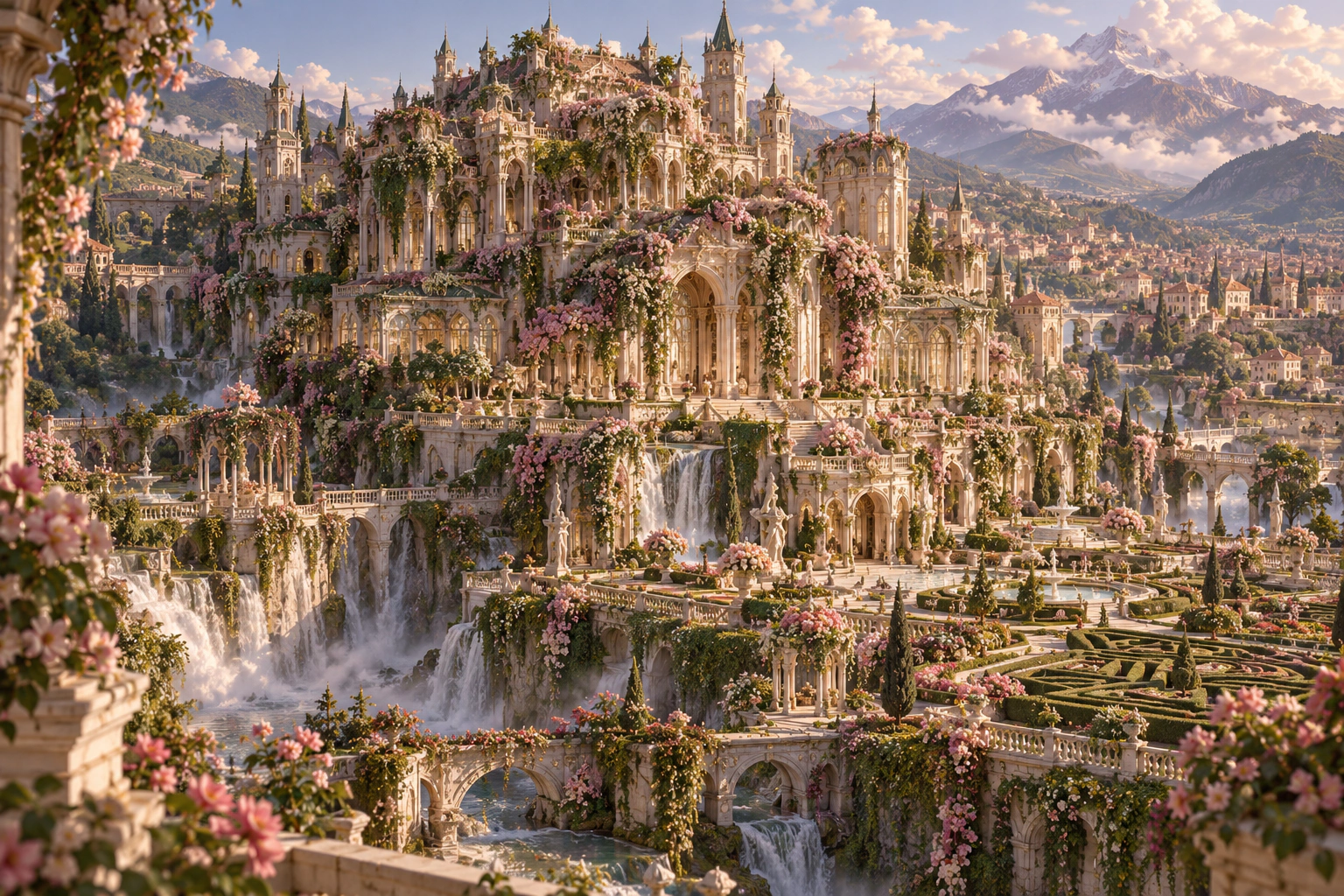
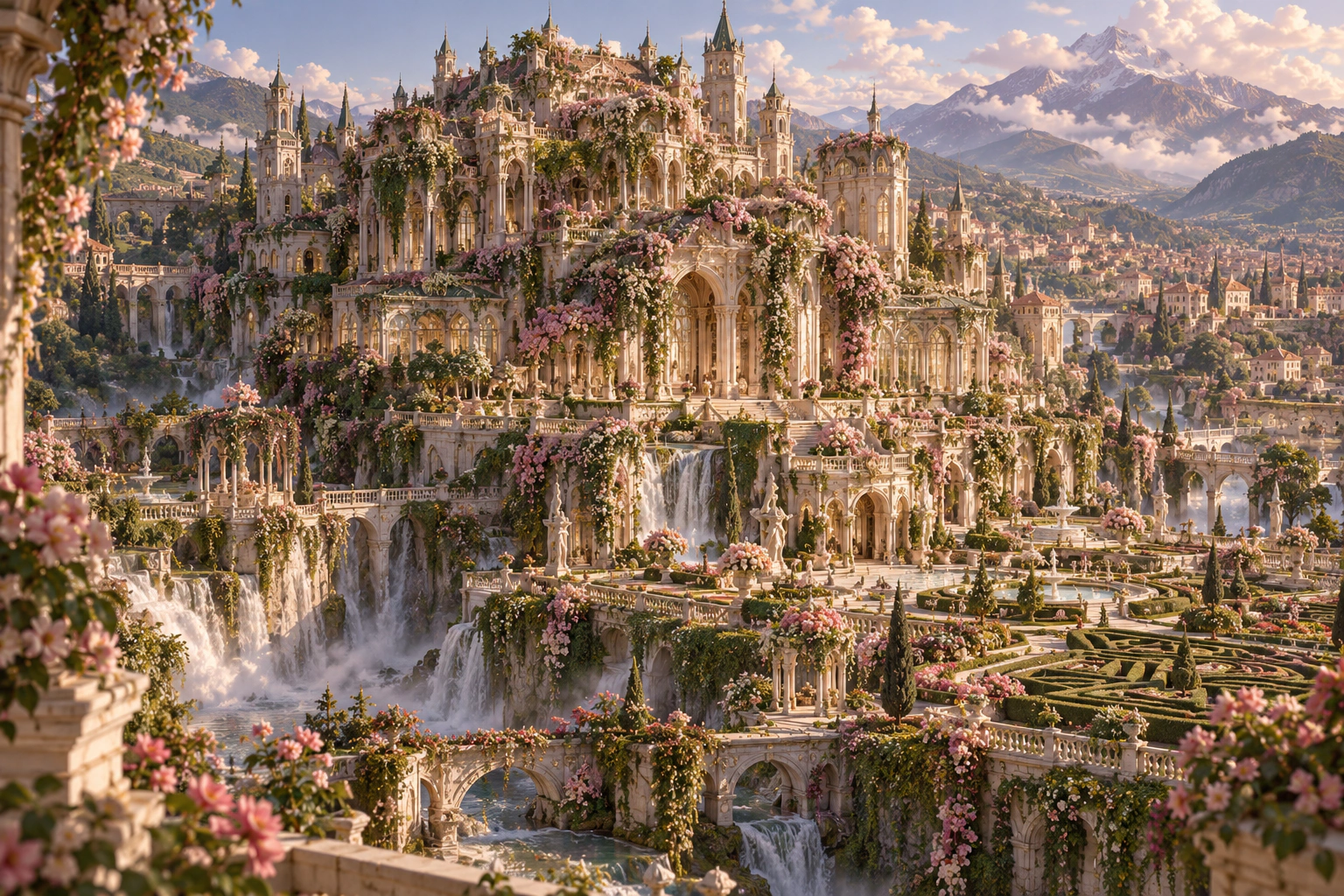
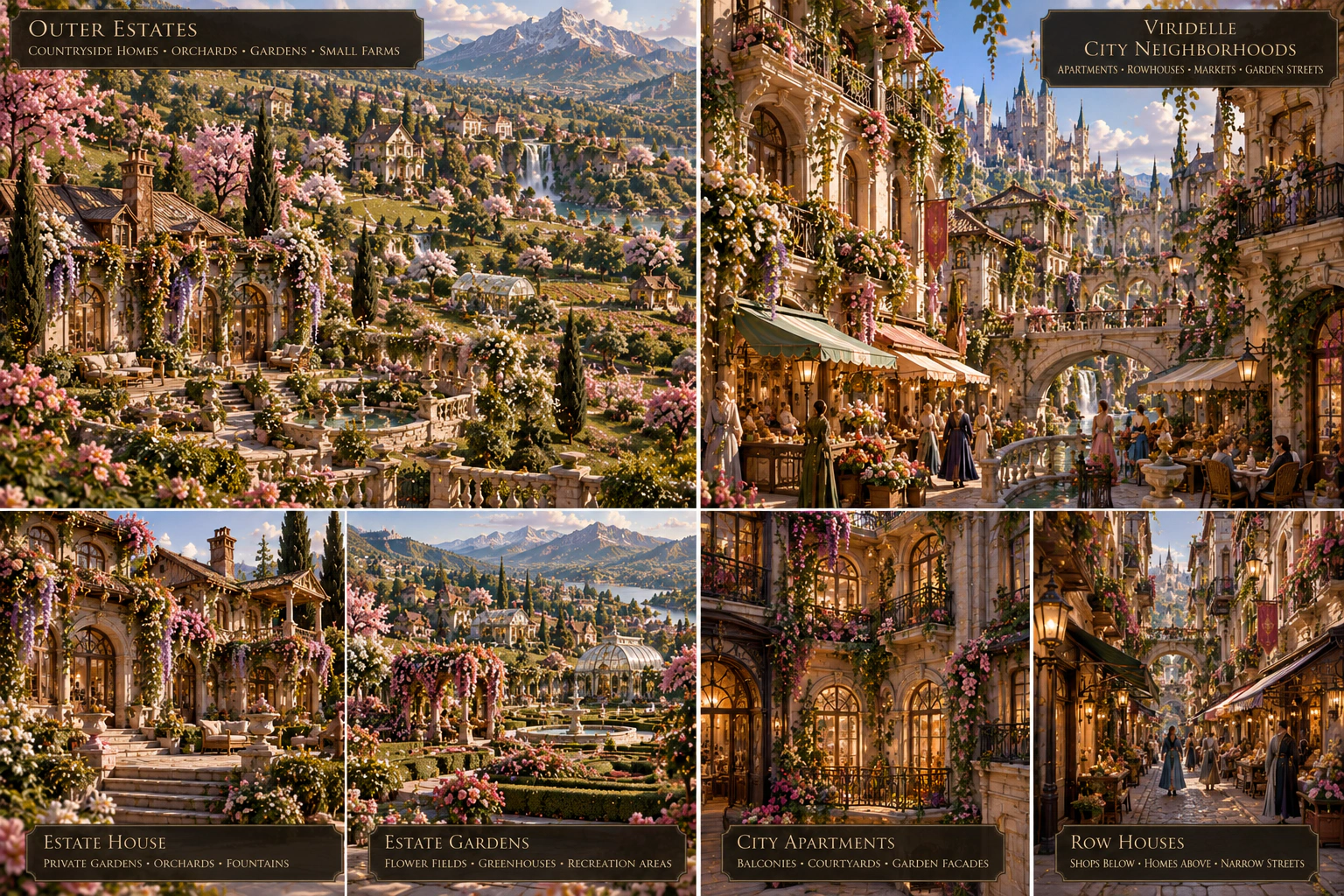
Viridelle is a sprawling garden-city.
Its outer districts resemble an idealized cottage countryside. Homes and family estates sit on generous pieces of land surrounded by gardens, orchards, hedges, flower fields and small farms. Roads wind between cultivated properties rather than forming rigid urban blocks.
Closer to the center, settlement becomes denser and more energetic. Cottage estates transition into lively garden neighborhoods filled with healers, apothecaries, markets, cafés, workshops, fountains and public gardens.
Large botanical gardens, flower fields, hedge mazes, sculpture gardens, orchards and meadow parks interrupt the urban landscape. A visitor can walk from a busy neighborhood into an enormous garden and temporarily forget they are inside a capital city.
At night Viridelle becomes quieter and intensely romantic. Lanterns illuminate garden paths and intimate outdoor dinners. Nocturnal flowers open throughout the city while fireflies, magical insects and other small creatures transform gardens that looked entirely different during daylight.
Royal Marriage and Succession
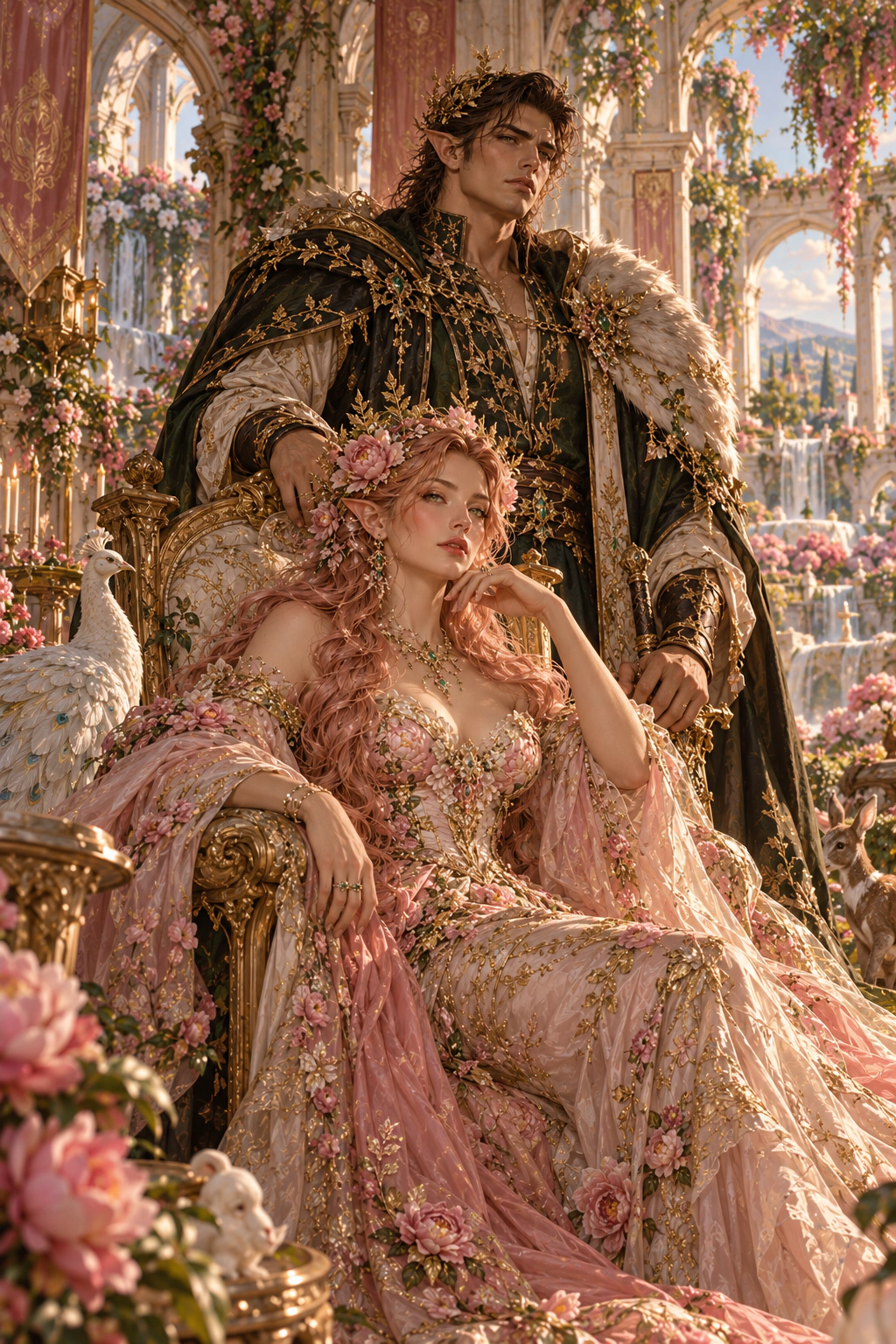
Rosellie and Leander are the Fae equivalent of humans in their late thirties to early forties.
They were politically matched when they were approximately equivalent to eighteen to twenty and have now spent nearly twenty human-equivalent years together. The marriage united Rosellie's ancient royal dynasty with one of Spring's major noble houses. Their arranged marriage unexpectedly became a genuine love match.
Their relationship is mature and lived-in rather than constantly romantic. They have private jokes, recurring arguments, intimate knowledge of each other's habits and deep trust developed through years of ruling together.
They can have vicious disagreements privately while presenting a completely unified royal front publicly.
Both participated in Viridelle's coronation land-bond and therefore jointly hold the Spring Court's connection to Faerie. Their complementary magic makes workings performed together particularly powerful.
Rosellie makes life flourish. Leander makes life survive.
Rosellie's family has ruled Spring for millennia, making the dynasty one of the oldest continuous ruling lines within Seelie.
Succession normally continues through royal lineage.
Rosellie and Leander currently have no children. Because both remain relatively young by Fae standards, this has not yet become a genuine succession crisis, although their childlessness attracts considerably more attention in fertility-obsessed Spring than it would elsewhere.
Queen Rosellie
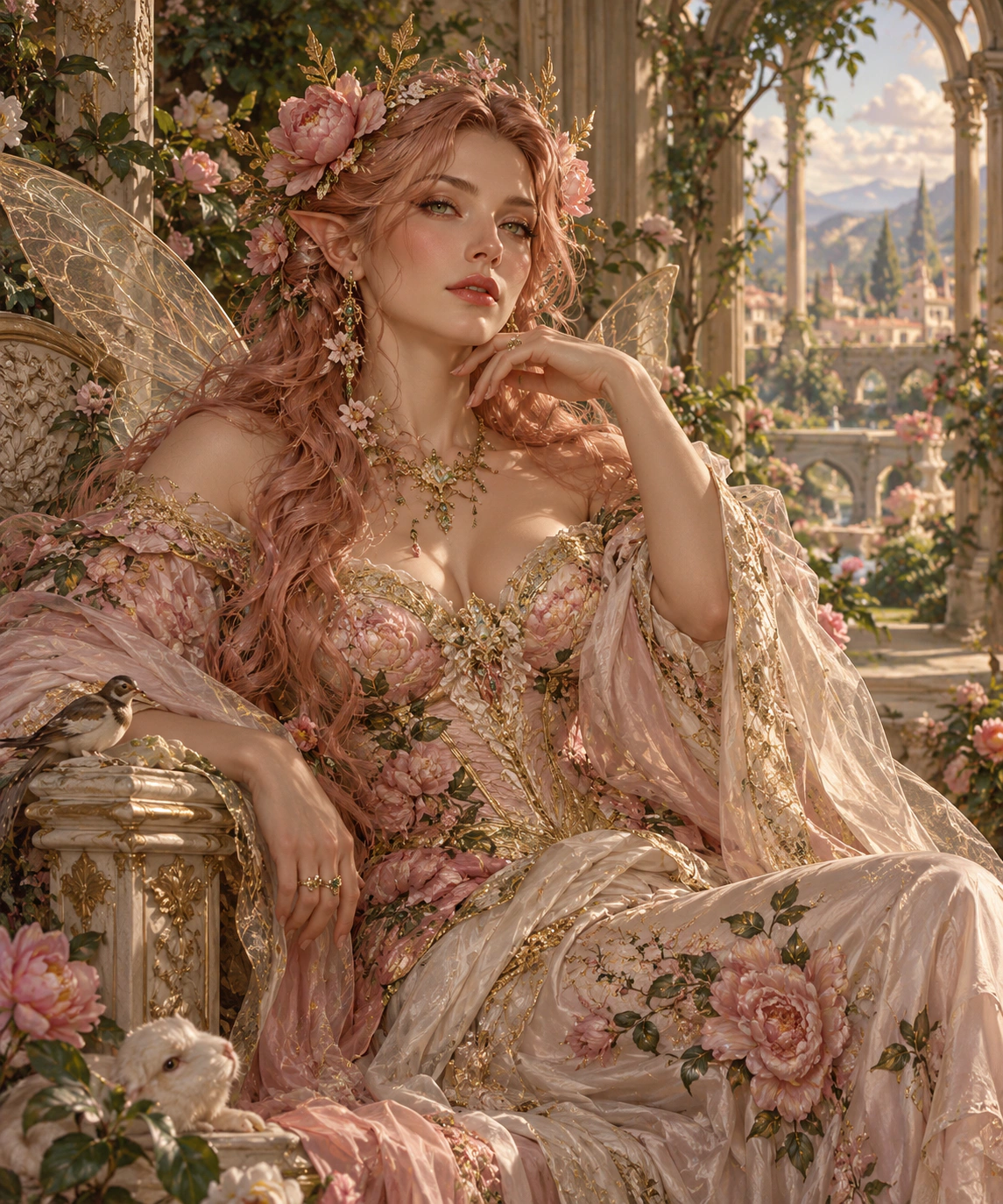
Rosellie is the warm public face of Spring.
Her magical identity centers on growth, healing, fertility and cultivation. She can encourage living processes already present rather than create life from nothing.
She is socially confident, politically skilled and strongly associated with Viridelle's healers, gardens, celebrations and fertility traditions.
Rosellie's warmth should not be mistaken for political softness. She is an experienced monarch and considers herself an equal ruler rather than the ceremonial counterpart to her husband.
King Leander
Leander represents Spring's dangerous side.
His botanical magic favors thorns, roots, poisonous plants, constricting vines and aggressive growth. He also possesses an affinity for Spring storms, including wind, rain, atmospheric pressure and, under sufficiently powerful conditions, lightning.
He is quieter, more territorial and more intimidating than Rosellie.
Leander's protective instincts are simultaneously one of his strengths and his greatest personal flaws.
Architecture
Spring architecture uses cream stone, timber, plaster, painted wood, garden walls and extensive living vegetation.
Outer homes are soft and cottage-like, frequently half-consumed by gardens. Architecture becomes larger and more formally Seelie toward central Viridelle while retaining flowers, vines, courtyards and living greenery.
The royal palace began as a traditional high-Seelie palace. Over generations it has been increasingly overtaken by Viridelle itself.
Briars climb columns. Vines cross ceilings. Roots curl through ancient stone. Branches enter windows and become permanent parts of rooms. Gardens spill directly into palace halls.
Much of this vegetation is magically responsive. Vines move aside for familiar inhabitants, flowers react to nearby Fae and branches provide resting places for animals. Animals freely wander through many garden-facing areas of the palace.
The palace is still recognizable as deliberately constructed Seelie architecture. Nature has not destroyed it; generations of Spring magic have integrated living growth into it.
People and Culture
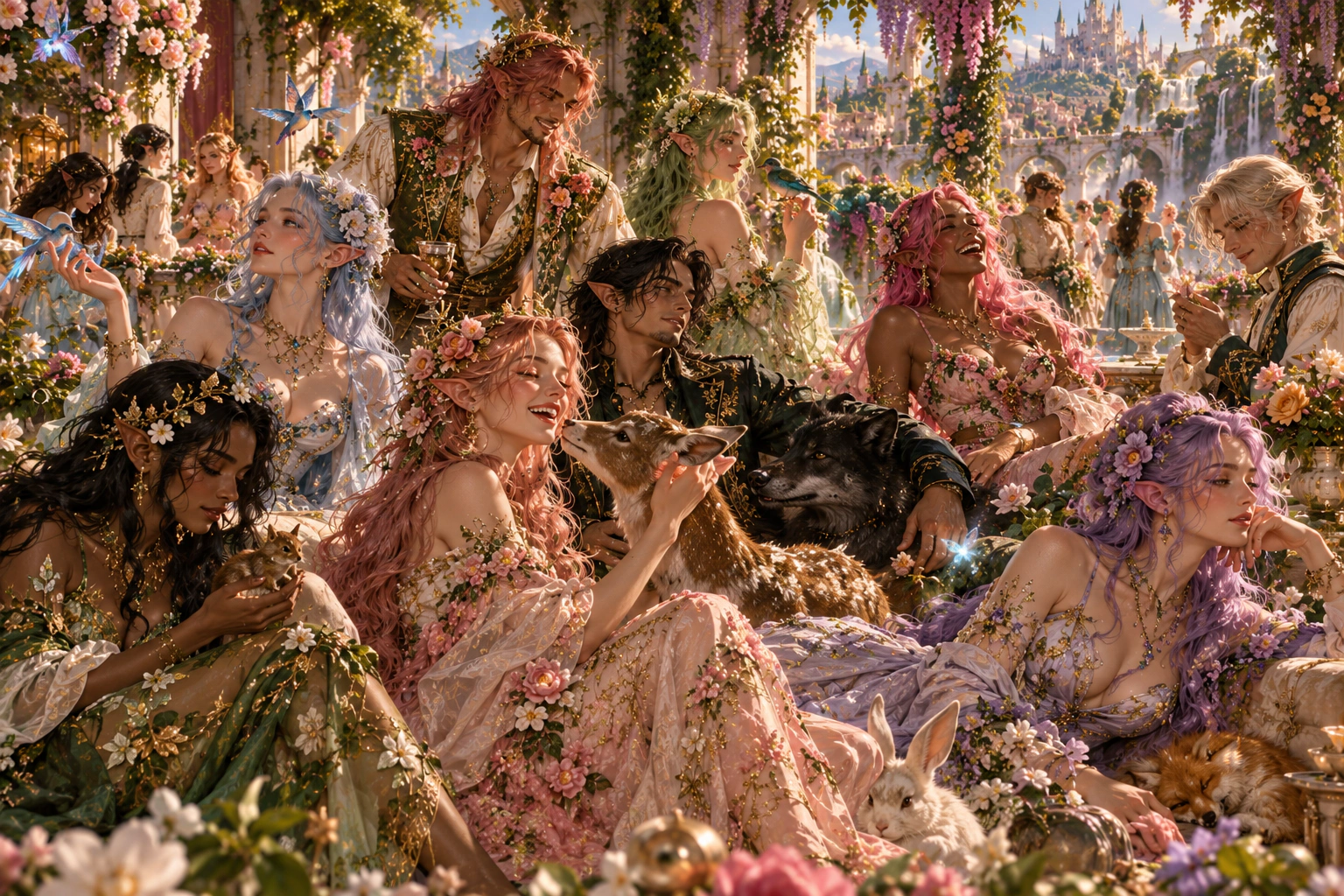
Spring Fae are commonly nicknamed Sprigs.
Outsiders often stereotype them as affectionate, cheerful, flirtatious, nurturing, meddlesome and harmless. The stereotype misses their competitiveness and territorial instincts. Spring culture can become extremely protective when its families, communities or land are threatened.
Courtship carries greater cultural importance here than casual sex. Casual relationships exist, but Spring romantic culture places greater emphasis on affection, pursuit, commitment, marriage and building a life together.
Marriage is strongly celebrated.
Children are raised communally compared with much of Faerie. Parents remain important, but extended relatives, neighbors and close family friends are expected to participate heavily in a child's life. Because Fae births are rare, children receive enormous
communal attention.
Fashion is soft, romantic and botanical. Flowing fabrics, embroidery, ribbons, floral jewelry, flowers and cottage-inspired clothing remain fashionable even among wealthy Spring Fae, although expensive materials and craftsmanship distinguish elite dress from rural clothing.
Fertility and Social Pressure
Viridelle is the foremost center of fertility medicine in Faerie.
Fertility is not merely medical here. It is culturally associated with Spring itself: renewal, birth, continuation and the creation of new life.
This creates one of the Court's most significant internal contradictions.
Healers and those who raise families receive substantial social respect. Marriage, pregnancy and children can become markers of perceived personal fulfillment. Relatives commonly interfere in romantic lives, and noble families can place much stronger pressure on their members to marry and reproduce.
Infertile Fae, voluntarily childfree Fae, unmarried adults and people uninterested in conventional courtship can consequently feel pitied, pressured or treated as though something is missing from their lives.
A growing cultural movement challenges this assumption. Younger Spring Fae in particular increasingly argue that Spring represents life and renewal rather than reproduction alone.
Traditionalists fear that removing fertility and family from the center of Spring identity means abandoning part of what makes the Court Spring.
This disagreement is a cultural and generational conflict, not an organized rebellion.
Healing and Medicine +
Viridelle is considered the best place in Faerie for fertility treatment and one of its greatest centers of medicine generally.
Medicine is distinctly Fae rather than modern. Healing houses contain private treatment chambers, medicinal gardens, baths, apothecaries and spaces for traditional physical medicine. Treatment can combine healing affinities, vitality magic, herbs, potions, nutrition
and mundane medical knowledge.
Magic cannot simply manufacture fertility, create life or guarantee conception. Fertility specialists identify and treat conditions that prevent living bodies from functioning as they otherwise could.
Spring medicine is practiced through independent master healers, family practices and prestigious Crown-supported healing houses.
Medical skill is one of the highest-respected accomplishments in Spring society.
Historically, Spring healers treated Seelie and Unseelie patients alike. As relations between the two peoples deteriorate, Solenar increasingly pressures Viridelle to restrict Unseelie access to its healers and medicines. Rosellie and Leander strongly oppose those restrictions.
Magic
Spring Fae can possess any affinity permitted by normal Fae inheritance, but Viridelle's environment makes certain affinities more common across generations.
Growth, plants, healing, vitality, animals, rain, fertility-related biological magic and other expressions associated with living ecosystems appear frequently.
These remain tendencies rather than universal Spring abilities.
Agriculture itself is not dependent on constant magical intervention. Viridelle's perpetual spring climate, extraordinary soil and generations of agricultural expertise make conventional cultivation extremely productive. Magic supplements this system rather than replacing farming.
The First Bloom
The First Bloom is Spring's greatest annual celebration and its cultural celebration of love, renewal and new beginnings.
Rosellie and Leander choose its date each year. On that day, their connection to Viridelle triggers an enormous coordinated flowering throughout the Court.
Lovers exchange living flowers whose species, color and arrangement communicate specific sentiments. Public declarations of courtship are common.
Romantic gossip becomes practically a public sport during the celebration, particularly when prominent nobles, royals or famous Fae are involved.
Fertility healers traditionally offer special treatments and blessings. Viridelle fills with communal feasts, music and dancing, while flowers and floral clothing can communicate relationship status.
The First Bloom celebrates love rather than sexual excess. It is culturally distinct from the pleasure-centered celebrations of the Pearl Isles.
Government
Rosellie and Leander hold substantial joint monarchical authority.
Beneath them, professional institutions—particularly healers and agricultural organizations—possess meaningful political influence because the kingdom materially depends upon their expertise.
This does not make the healers or growers constitutionally superior to the Crown. Their power is practical: rulers cannot govern the agricultural and medical center of Seelie effectively while ignoring the people responsible for maintaining those systems.
The Spring monarchy ultimately exists beneath Kaenyn's High Seelie Crown in Solenar.
Economy
Spring is the biological and agricultural powerhouse of Seelie.
Major outputs include food, herbs, medicines, healing ingredients, flowers, seeds, fruits, cultivated plants and plant-based magical materials. Its medical expertise is itself an important source of international influence.
Its specialization creates significant weaknesses.
Spring is comparatively poor in metals, weapons manufacturing and heavy industry. It also lacks the maritime infrastructure of the Pearl Isles.
Viridelle therefore depends upon other kingdoms for important manufactured goods, metals, weaponry and large-scale overseas commerce.
Other kingdoms, in turn, depend heavily upon Spring for food, medicine and biological resources.
Military
Viridelle maintains a moderate professional military and is currently expanding its military readiness as tensions throughout Faerie worsen.
Spring warfare is strongest defensively.
Its forces favor rangers, archers, mounted patrols and fighters trained to exploit familiar countryside. Defensive magic can make use of briars, poisonous vegetation, concealed routes and rapidly changing living terrain.
The same gardens, hedges, forests and agricultural landscapes that make Spring appear idyllic can become serious obstacles to an invading army.
Viridelle is consequently much easier to admire than to conquer.
As political tensions worsen, Spring is moving toward a larger military establishment, reflecting a broader trend among most major Fae kingdoms. The Summer Court remains a notable exception because the Pearl Isles continue to devote far less attention to military expansion.
Relationships
Public Reputation
Viridelle's reputation depends heavily on who is speaking.
Romantics imagine flowers, courtship and beautiful gardens. Families think of fertility and children. The sick think of healers. Merchants think of herbs, medicine and food. Soldiers know that Spring is considerably harder to invade than its appearance suggests.
Critics see Sprigs as intrusive, overly romantic and obsessed with reproduction.
Spring Fae generally see themselves more simply: they cultivate things worth keeping alive.
Current State
The Spring Court is prosperous but increasingly uncomfortable with the direction of Seelie politics.
Its military is expanding. Solenar is pressuring its medical institutions over Unseelie patients. Relations with Autumn are deteriorating. Younger Spring Fae are challenging traditional assumptions surrounding fertility, marriage and children.
None of these problems currently threaten the kingdom's existence. Together, however, they are beginning to force Spring to decide which traditions actually represent its values and which have merely survived because nobody previously challenged them.
Possible plotlines
Rosellie and Leander still genuinely love one another when the story begins.
However, Leander's protective and territorial instincts are beginning to become controlling as international tensions worsen.
Believing Rosellie's diplomatic openness toward Autumn and Unseelie medical access places her and Spring at risk, Leander begins privately interfering with decisions she has already made. He may intercept correspondence, prevent meetings or countermand diplomatic arrangements without her knowledge.
He believes he is protecting his wife and kingdom.
For Rosellie, the discovery is a fundamental betrayal because their marriage and joint monarchy were built upon equality and trust.
Her eventual encounter with her true mate does not magically destroy her marriage and does not compel her to leave Leander. Instead, the relationship eventually contributes to Rosellie recognizing what she wants from her own life and finding the courage to make that choice herself.